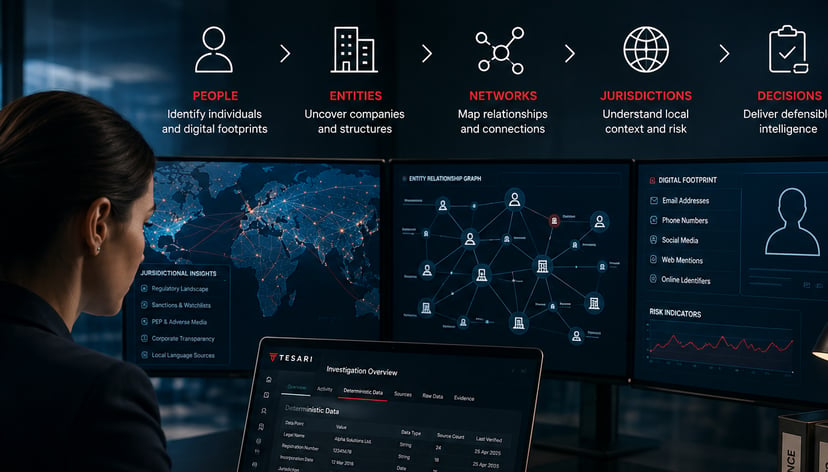
Where are Modern OSINT Investigations Headed?
The Coalition of Cyber Investigators and guest contributor, Elisar Nurmagambet, CEO and Cofounder of Tesari AI, explain why the latest version of the Tesari platform could be a game-changer for modern-day cross-border and complex investigations.
There is a clear shift going on across the investigations and intelligence space. The old approach of running isolated checks against static data sets is no longer adequate for today’s risks.
Cross-border investigations are becoming more complex, more interconnected, and far more time-sensitive. Export controls, sanctions exposure, procurement fraud, supply chain compromise, hidden ownership structures, digital identities and jurisdictional differences rarely fit neatly inside a single company profile or screening result.
That is what makes the latest Tesari update genuinely interesting.
The arrival of Tesari vAlpha 1.5 is a clear indication that the platform is evolving past the idea of “search” as most people in compliance or investigations would understand it. What is remarkable is not just the quantity of data or the presence of AI-powered features. It’s how the platform is starting to reflect how real investigations happen in the real world.
Inquiries seldom proceed in a straightforward or obvious manner. One lead might start with a person's name, then lead to a corporate filing, then to a second jurisdiction, then to a broader network through digital traces, ownership records, or sources in a local language. A regional filing or a small regulatory reference can change the meaning of the whole investigation in many cases.
It is in that chain of investigation where a lot of traditional tools start to flounder
Investigations are Rarely Straight Lines
The expansion into jurisdiction-specific investigative workflows across 206 countries is one of the strongest additions in this release.
These days, global search capabilities are common enough. Much more difficult to understand what matters in each jurisdiction. Disclosure standards vary, corporate registries vary, naming conventions vary, languages vary, legal systems vary, cultural nuances vary, and all these things affect how intelligence should be interpreted.
Tesari seems to be right in his approach to recognising reality.
Rather than just making every country another searchable dataset, the platform has dedicated workflows that are designed to reflect local realities. For investigators, analysts and compliance teams working across borders, context often makes the difference between finding something operationally useful and just adding to the noise.
This is important because investigators are no longer looking for information alone. They also need to understand relevance, risk, relationship and intent.
This reflects a broader shift within modern investigative practice. The Coalition of Cyber Investigators has repeatedly highlighted the growing importance of contextual open-source intelligence (OSINT) analysis, evidential integrity, and investigator-led workflows in cross-border investigations and intelligence development.
The Shift Towards Person-First Investigations
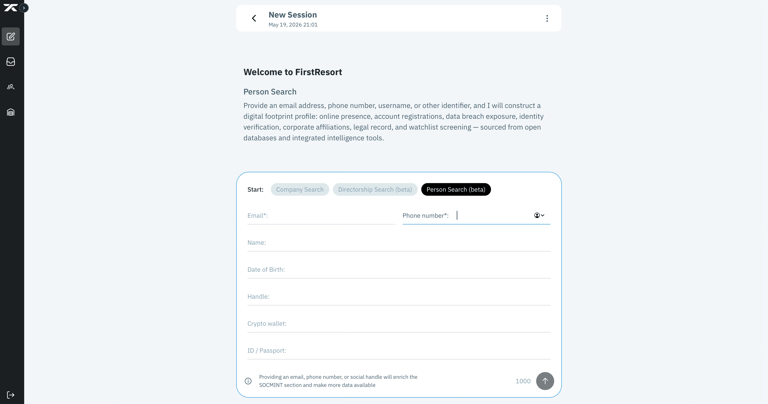
Another significant development is the introduction of Person Search and Digital Footprint Search functionality.
This feels like a natural evolution.
Inquiries increasingly don’t begin with a company name. They start with a person, an email address, a phone number or bits of an online identity. From there, investigators branch out to identify networks, ownership links, aliases, digital traces, associated entities, and behavioural patterns.
Tesari now supports investigations beginning with:
- Legal entities
- Directors and owners
- Individuals and digital footprints
The integration with OSINT Industries significantly strengthens that workflow. Starting with only minimal identifiers and gradually expanding outward reflects how practitioners often operate in live investigations.
Crucially, this change appears to have been motivated by practitioner feedback. In theory, changing the workflow from company-first to person-first investigations is easy. In practice, it requires strong entity resolution capabilities to avoid weak or misleading connections.
That kind of development takes time.
The Coalition of Cyber Investigators has also explored how OSINT methodologies increasingly support industries far beyond traditional cyber investigations, including legal services, insurance, fraud detection, sustainability reporting, and due diligence.
Structured Investigative Data and Evidential Transparency
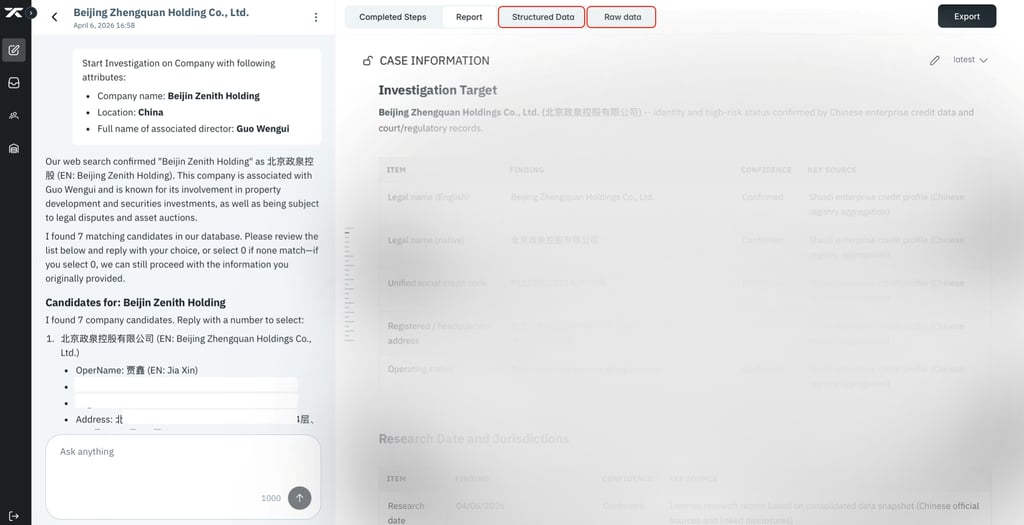
One of the more important elements of the update may receive the least public attention outside investigative circles.
Tesari’s Deterministic Data layer introduces structured, auditable visibility into the formation of investigative conclusions.
That includes:
- Source transparency
- Access to raw investigative data
- Traceable investigative steps
- Structured deterministic datapoints
For organisations facing enforcement risk, litigation exposure, regulatory obligations, or evidentiary standards, this matters enormously.
There has been growing concern across the industry about “black-box” artificial intelligence (AI) systems that produce outputs without clear traceability. Investigators and compliance teams cannot simply rely on a platform telling them something is risky without being able to explain why.
Especially when regulators, courts, enforcement bodies, or legal teams may later ask a very direct question:
“How did you reach that conclusion?”
Deterministic data solves that problem. It makes findings transparent, reviewable and defensible.
The ability to demonstrate how a conclusion was reached, where the information came from, and how the assessment was made is much closer to defensible intelligence than to automated guesswork.
And that distinction is growing more important every year.
The Growing Pressure on Investigators
Regulators are putting greater pressure on organisations to identify risks sooner, properly document decisions and act before issues become enforcement matters – and for courts, transparency and full documentation of the process used to collect, analyse and prepare evidence has long been a key requirement
These requirements presented a challenge to speed and accuracy.
The future of investigations probably won’t be adding more screening tools on top of broken workflows. It will come from helping investigators move quickly through people, entities, jurisdictions, networks, and contextual intelligence while maintaining evidential integrity throughout.
That’s where platforms like Tesari seem to be positioning themselves – not as another database or another generic AI assistant. But as an operational investigatory capability, designed around the way modern intelligence works.
A Platform that Is Listening to Practitioners
Perhaps the most encouraging aspect of the update is that the development direction appears grounded in operational reality rather than marketing language.
The additions in vAlpha 1.5 suggest a platform being shaped by practitioners who understand the friction points investigators face daily:
- Fragmented workflows
- Disconnected data
- Weak contextual understanding
- Auditability concerns
- Cross-border complexity
- Difficulty moving between individuals and entities
The combination of tradecraft and jurisdiction-specific workflows, deterministic data, transparent auditability, and person-first investigations makes Tesari increasingly relevant for both proactive intelligence development and reactive investigations.
Tesari is in constant evolution, but it's fast becoming a serious capability for investigators, analysts, intelligence professionals and compliance teams operating in environments where complexity is no longer the exception. It's the standard.
If you work in sanctions, procurement integrity, export controls, corporate investigations, financial crime, due diligence, or intelligence development, this is one platform to watch.